pyLick#
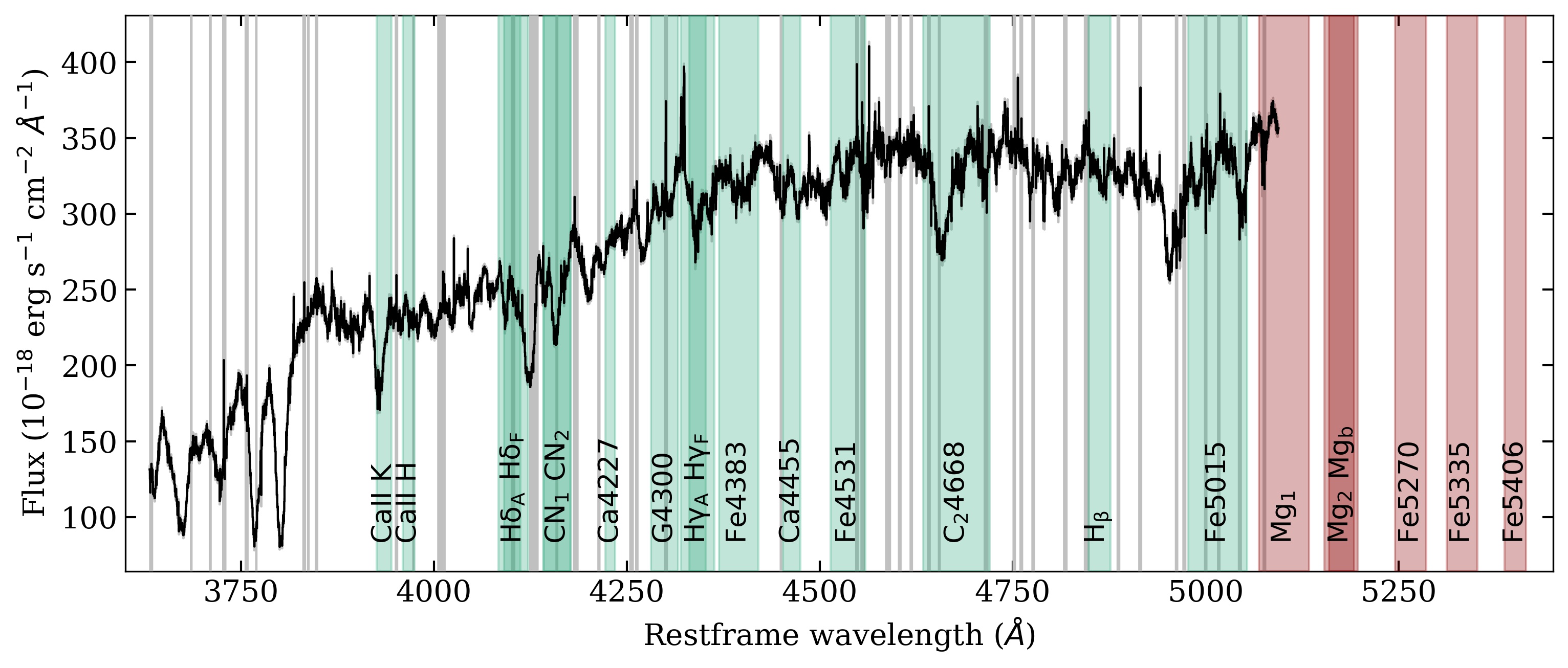
pyLick is a Python tool designed to measure spectral features, such as Lick indices and D4000, in galaxy spectra. It currently supports over 80 features spanning the near-UV to the near-IR. New ones can be easily introduced. The uncertainties are evaluated using the signal-to-noise method proposed by Cardiel et al. (1998). The code interpolates over bad pixels when a bad pixels mask is provided, allowing users to discard measurements above a specified Bad Pixel Fraction threshold. Additionally, the code includes convenient plotting routines.




Installation#
pylick can be installed using Pypi:
pip install pylick
For more flexibility, clone the source repository into your working folder and install it locally:
git clone https://gitlab.com/mmoresco/pylick.git
cd pylick/
pip install -e .
To test the installation, run the following command:
python -c "import pylick; print(pylick.__version__)"
License & Attribution#
pylick is free software made available under the GPL-3 License. For details see the LICENSE.
If you find this code useful in your research, please cite the following paper (ADS, arXiv, INSPIRE):
@ARTICLE{Borghi2022a,
    author = {{Borghi}, Nicola and {Moresco}, Michele and {Cimatti}, Andrea and et al.},
     title = "{Toward a Better Understanding of Cosmic Chronometers: Stellar Population Properties of Passive Galaxies at Intermediate Redshift}",
   journal = {ApJ},
      year = 2022,
     month = mar,
    volume = {927},
     pages = {164},
       doi = {10.3847/1538-4357/ac3240},
    eprint = {2106.14894},
    adsurl = {https://ui.adsabs.harvard.edu/abs/2022ApJ...927..164B},
}
The team#
Main developers:
Contributors: - Alexandre Huchet - Lucia Pozzetti - Andrea Cimatti
Documentation#
User Guide
Tutorials
Changelog#
0.2.0 (2022-06-02)#
Code refactored.
Integrate automated benchmark testcase from Borghi et al. (2022a) for next versions.
Extend line lists to UV and NIR.
New documentation with better examples and more discussion.
0.1.0 (2021-06-28)#
Initial release.